When it comes to authenticity in a novel, it’s all down to research, research, research and at times some expert advice. Not everyone knows where to look, so today formerDCI Stuart Gibbon, is talking to lifeofcri.me about his transition from writing factual police reports into helping write fictional police procedurals.
FROM HELPING FIGHT CRIME TO HELPING WRITE CRIME
My name is Stuart Gibbon and I’m a former police DCI turned Writing Consultant.
My story began in the early 1980’s when I travelled from my native north-east of England down to London at the ripe old age of 16 to join the Metropolitan Police as a cadet. A couple of years later I passed out (fortunately not literally) from the police training college at Hendon as a fully-fledged Police Constable. For the next 18 years I worked in uniform and CID on the streets of north-west London.
In 2000 I transferred to the East Midlands where my police career continued with promotion through the ranks to Detective Chief Inspector (DCI). As a large part of my police career was spent as a Detective I was able to gather lots of experience in crime investigation and detection. As a Senior Detective I was in charge of Murder and other serious crime cases.
On retiring from the police service in 2012 I still wanted to help people and had always maintained an interest in reading books. I decided to set up GIB Consultancy to offer advice to writers to ensure that their work is not only procedurally accurate but also authentic. I contacted the Crime Writers’ Association and circulated my details where possible. Since then I have been working with a number of writers across a diverse range of topics from standard police procedure, missing persons and Coroner practices to forensic evidence, kidnapping and Murder investigation.
My first written acknowledgement arrived courtesy of Tammy Cohen as a result of my advice for her novel Dying For Christmas published in 2014. I have recently advised C.L. Taylor on her massive hit The Missing and I’m currently working with her on her fourth psychological thriller which is due out next year. Although the majority of requests for advice are from crime writers, I have helped writers of other genres who may wish to include something police-related in their story.
In addition to the advisory service I also talk with Writing Groups and at festivals/conferences on the subject of ‘Murder Investigation’ and the challenges facing a Senior Detective in charge of such cases. The talk/workshop is designed to give writers ideas for their work and to ensure that any procedures are realistic.
My new ‘career’ is every bit as challenging and rewarding as my previous one. It’s great to be able to play a part in helping to produce something which is going to be enjoyed by so many people.
I have a website at http://www.gibconsultancy.co.uk and would welcome any writers who would like any advice or just the odd question or two answering to contact me as I am sure I would be able to help.
As part of the blog tour for the latest Geraldine Steel novel ‘Murder Ring’ Leigh Russell talks to LifeOfCri.me about where some of her inspiration came from.
My inspiration for Murder Ring
Inspiration comes from all sorts of places, in various guises. Agatha Christie famously said that the best time for planning a book is while you’re doing the dishes. Even though nowadays most of us have dishwashers, we all know what she meant. I can be sitting at home, or out and about, when an idea occurs to me and off I go. Ideas can come from anywhere. It might be a person I’ve noticed who sparks off a story, or an atmosphere in a strange place, or just a large suitcase, large enough to hide a body…
The inspiration for Murder Ring came about in a slightly unusual way for me, more calculated than in my other books. Usually I’m inspired to write about something that interests me, but this time, ironically, my starting point was a topic that didn’t interest me at all. In the fourth book of the series, Geraldine Steel moved to London. By the time I started to think about Murder Ring, the eighth in the series, I decided I couldn’t continue setting a detective in North London in the present day without ever mentioning guns. The problem was that not only did I know nothing about guns, they aren’t a topic that inspires me at all. Nevertheless, in the interests of authenticity, I decided to bite the bullet, if you’ll excuse the pun. So tackling the issue of gun crime was a conscious choice, rather than an idea that inspired me.
One of my advisors is a police ballistics expert, but his information was not what interested me the most once I began to look into the subject. My research led me in a different direction, looking into the kind of people who were likely to be in possession of guns in London. Most of them are not criminal masterminds, but dysfunctional people. Older teenagers in gangs frequently give their firearms to young siblings to look after in order to avoid detection, knowing the children are too young to be prosecuted if found in possession of a gun. It was in the news recently that children as young as ten were among fifteen hundred children held over alleged firearm offences in the UK in the three years to January 2016. Such statistics are worrying, and are only likely to worsen as guns are so readily available.
The more I looked into the subject, the more I realised that while guns themselves don’t interest to me, what they represent fascinates me as a writer of crime fiction. People often use self-defence as an excuse for owning guns, but guns are essentially a means of exerting power. And for a crime writer, villains seeking to control or eliminate their victims is always interesting. So although guns in themselves are merely mechanical instruments of death, introducing them into Murder Ring opened up new possibilities for creating villains. Because what makes guns frightening is not the weapons themselves, but the people who use them.
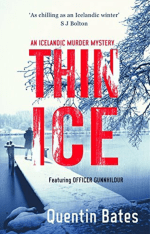
Quentin Bates was born in England and through a series of coincidences found himself working in Iceland for his gap year. One year turned into ten, plus a wife and children. After a move back to the UK he began work as a nautical journalist and editor of a commercial fishing magazine. His Gunnhildur Gisladottir series was born through the author’s own inside knowledge of Iceland and its society, along with the world of exploring crime.
Thin Ice is the fifth installment in the Officer Gunnhildur series and is available now.
As part of the Thin Ice blog tour, today Quentin takes the LifeOfCri.me 12 word challenge.
Rules
Answers should be complete sentences, and completed in no more than 12 words (unless otherwise stated)
Contractions count. It’s = 2 words.
LOC: You’ve just released Thin Ice, the fifth in your series featuring Officer Gunnhildur, what can you tell us about it?
QB: Two villains, two kidnapped women, a bag of cash and no petrol.
LOC: Gunnar has an interesting home life, is this typical of an Icelandic lifestyle, and to the more European lifestyle, or as unplanned for you as it was for Gunnar & Gisli?
QB: It just evolved, but she copes with everything I chuck at her.
LOC: What’s the most challenging part of switching between writing your own novels and translating those of others?
QB: No problem. It’s the same toolbox but a different set of tools.
LOC: How would you describe your writing process?
QB: There’s plenty of swearing and watching the kettle boil.
LOC: What’s the most surprising thing you’ve learnt in your writing career?
QB: I never imagined a gang of crimewriters could be so much fun.
( LOC: Ooh… crimewriters, not crime writers? That’s skating on “Thin Ice” with the word count…. 😉 )
LOC: What’s the best book you’ve read in the last twelve months?
QB: Jonathan Dark or the Evidence of Ghosts by AK Benedict
LOC: Why?
QB: Tough choice, but this book is bonkers, magnificently imaginative and just enthralling
LOC: Describe your perfect day
QB: Distant mountains, sounds and smells of the sea, fish for dinner.
and finally just for laughs……
LOC: Thanks to authorLeigh Russellyou have just woken up to find yourself on stage in front of the judges of Britain’s Got Talent, with a stick of celery, a top hat and a panda. What do you do?
QB: Bribe panda with celery to wear hat for winning Fred Astaire impression.
Leigh Russell is the author of the internationally bestselling Geraldine Steel and Ian Peterson crime series. She studied at the University of Kent, gaining a master’s degree in English. She has a Diploma in Specific Learning Difficulties from the British Dyslexia Association, and a Certificate in Teaching English as a Foreign Language. For many years she taught English at secondary school, specialising in supporting pupils with specific learning difficulties. She is married, has two daughters, and lives in north-west London. In addition to writing, she guest-lectures for the Society of Authors, universities and colleges, and runs regular creative writing courses for the prestigious Writers Lab in the UK and Greece. She also runs the manuscript assessment service for the CWA.
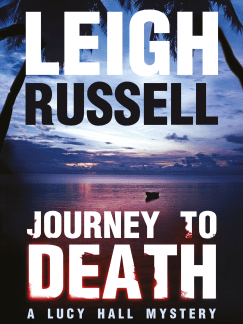
Her latest novel Journey To Death, the beginning of a new series featuring protagonist Lucy Hall, is released today and to celebrate Leigh has taken the LifeOfCri.me 12 word challenge.
Rules
Answers should be complete sentences, and completed in no more than 12 words (unless otherwise stated)
Contractions count. It’s = 2 words.
LOC: What can you tell us about your latest release Journey To Death?
LR: In the Seychelles, Lucy Hall is drawn into a life threatening adventure.
LOC: What was it like making the change from writing your regular characters and starting a new series?
LR: So far it has been great fun, but Geraldine Steel is continuing.
LOC: How would you describe your writing process?
LR: The process is completely chaotic, frequently exhausting and always exciting.
LOC: What’s the biggest challenge you’ve faced in your writing career?
LR: There have been several, including facing a man with a machine gun.
LOC: What’s the best book you’ve read in the last twelve months (title & author not in word count) and why?
LR: I reread The Hobbit by J R Tolkien – sometimes a break from adult fiction is necessary.
LOC: What’s the weirdest sentence you’ve ever written / read? (word count does not apply)
LR: ‘Word count does not apply.’ I feel like a dog let off the lead and free to ramble! I’ve read a lot of weird sentences, and no doubt written quite a few, but one that comes to mind is the opening sentence of ‘The Outsider’ by Albert Camus. The book opens with the words: ‘Aujourd’hui maman est morte.’ This sentence can be translated as ‘Today mother died’ but a more literal translation would be: ‘Today mother is dead’, which sounds more final. The beautiful simplicity of the language is not weird at all. But the bald indifference of the statement, combined with the emotive content, is weird and makes it one of the most chilling first sentences I have ever read. It sets the tone for a disturbing novel.
LOC: *rolls eyes* give an author some wriggle room, and off they go…. 😀
LOC: Describe your perfect day
LR: I have breakfast in bed, before writing all day.
and finally just for laughs……
LOC: Thanks to author Angela Marsons you have just woken up to find yourself on stage in front of the judges of Britain’s Got Talent, with an ironing board, a box of matches and an armadillo. What do you do?
LR: I set fire to the ironing board and escape on the armadillo.
You can keep up to date with all Leigh’s current and forthcoming releases on her website www.leighrussell.co.uk or by following her on Twitter @LeighRussell
Recently racking up her 1,000,000th book sale since Silent Scream was first published in February, Angela Marsons is the author of the DI Kim Stone crime thrillers, set in ‘The Black Country’ at the heart of the West Midlands.
Brought up in a series of foster homes, Kim is a no nonsense copper, determined to get to the bottom of every crime she comes across, whatever the cost, or the consequences.
Today on LifeOfCri.me, Angela takes on our 12 word challenge.
Rules
Answers should be complete sentences, and completed in no more than 12 words (unless otherwise stated)
Contractions count. It’s = 2 words.
LOC: Your latest book Lost Girls is the third in your series featuring DI Kim Stone, what can you tell us about it?
AM: It is a kidnapping drama that evolves into an auction for life.
LOC: As a fellow biker, I’m intrigued that you’ve made Kim more than just a motorcycle rider, but a true “petrol-head” repairing and re-building motorcycles, what was behind this?
AM: She needed an interesting hobby that suited her inquisitive, puzzle solving personality.
LOC: How would you describe your writing process?
AM: The first draft is for me to write what I want fearlessly.
LOC: What’s the most surprising thing you’ve learnt in your writing career?
AM: That my gut is the most reliable organ in my body.
LOC: What’s the best book you’ve read this year (title & author not in word count) and why?
AM: A Sister’s Promise by Renita D’Silva. It is beautifully written and took me on an unforgettable journey.
LOC: Describe your perfect day
AM: There would be coffee, crisps, notepads, pencils and sunshine. And more coffee.
and finally just for laughs……
LOC: Thanks to author Matt Hilton you have just woken up to find yourself on stage in front of the judges of Britain’s Got Talent, with a waffle maker, a hamster and a kilt. What do you do?
AM: Wear the kilt and waffle the hamster. Not really, obviously. Love hamsters.
Published by Bookouture, all three Kim Stone thrillers are available now, and to keep up with Angela, you can find her on Twitter @writeangie
His latest novel Blood Tracks Introduces private investigator Tess Grey and Southern renegade ex-con Nicolas ‘Po’ Villere in the first of a brand-new series of fast-paced action thrillers.
Today on LifeOfCri.me, Matt takes on our 12 word challenge.
Rules
Answers should be complete sentences, and completed in no more than 12 words (unless otherwise stated)
Contractions count. It’s = 2 words.
LOC: You’ve just released your latest novel Blood Tracks, what can you tell us about it?
MH: It has a female lead, who is not Joe Hunter in tights.
LOC: What was behind your decision to take a break from your serial character Joe Hunter and begin a new series?
MH: To exercise my creativity and extend my commercial viability to female readers.
LOC: What’s the biggest challenge you’ve faced in your writing career?
MH: Winning over readers who complain Hunter isn’t Lee Child/Jack Reacher.
LOC: What’s the best book you’ve read this year (title & author not in word count) and why?
MH: “No One Gets Out Alive” by Adam Neville was intense and spooky and I do love a good scary story.
LOC: Describe your perfect getaway
MH: A log cabin in the Scottish highlands, preferably near a remote loch.
LOC: What is the strangest sentence you have written/read this week (limit does not apply)
MH: From my WIP: “Nicolas, I’m just shy of three hundred and fifty pounds, me; if I wore high heels I’d end up nailed to the sidewalk for the duration.”
and finally just for laughs……
LOC: Thanks to author C.L.Taylor you have just woken up to find yourself on stage in front of the judges of Britain’s Got Talent, with just a sledge, a grappling hook and some fish bones. What do you do? (12 words – minimum of one item.)
MH: Throw on furs; sit on the sledge singing White Fang the musical.
The latest instalment in Christopher Fowlers brilliant Bryant & May series is out now. London’s Glory is a collection of eleven Bryant and May short stories, filling in gaps and covering cases mentioned in passing over the years.
In the spirit and brevity of a short story, when I got the chance to ask a few questions of Chris, I asked simply, about the genesis of Bryant & May, where in London fans could visit for a feel of the books, and what Bryant and May would think of book tours and blogging. Here’s what he had to say.
Many years ago I fell in love with the Golden Age classic mysteries I found in the library, with their academic eccentricities and timeless view of an England that never really existed. There was just one problem; they badly needed an update because of outmoded attitudes to sex and race. I thought; wouldn’t it be interesting if you took the structure of the Golden Age mysteries and put them into our recognisable modern world?
If you’re going to describe the investigation of a crime, you might as well have fun with it. How does a writer create a detective? I started with a matchbox label that read “Bryant & May – England’s Glory”. That gave me their names, their nationality, and something vague and appealing, the sense of an institution with roots in London’s sooty past. London would be the third character; not the tourist city of guidebooks but the city of invisible societies, hidden parks and drunken theatricals, the increasingly endangered species I eagerly show to friends when they visit.
Every night, my detectives walk across Waterloo Bridge and share ideas, because a city’s skyline is best sensed along the edges of its river, and London’s has changed dramatically in less than a decade, with the broken spire of the Shard and the great ferris wheel of the London Eye lending it a raffish fairground feel.
By making Bryant & May old I could have them simultaneously behave like experienced adults and immature children. Bryant, I knew, came from Whitechapel and was academic, esoteric, eccentric, bad-tempered and myopic. He would wear a hearing aid and false teeth, and use a walking stick. A proud Luddite, he was antisocial, rude, miserable, erudite, bookish, while his John May was born in Vauxhall, taller, fitter, more charming, friendlier, a little more modern, techno-literate, and a bit of a ladies’ man. Their inevitable clash of working methods often causes cases to take wrong turns.
Then I threw every modern subject I could think of at them, from refugees to banking scandals, and let them sort out the dramas using old-fashioned (and vaguely illegal) methods. The result is, well, unusual!
The easiest locations to visit in the books are Waterloo Bridge, where the detectives walk most nights, and King’s Cross, where their unit is based, but in ‘The Victoria Vanishes’ there’s a list of all the pubs they visit in the books at the back. And all of the locations I use are real, so everything can be looked up and explored on Google maps!
I think John May would like blogging but Arthur Bryant would probably crash entire systems because he has a warped understanding of the internet!
When I was thinking about putting together this 12 word feature I put a shout out to my author friends on Facebook, and delightfully C.L Taylor was amongst the first to put her hand up in the air and say she’d give it a whirl. Author of thrillers The Accident (released as Before I Wake in the US) and The Lie, here’s a big thank you from LifeOfCri.me for taking up the challenge, and in turn her fabulous response.
The Rules
Answers should be complete sentences, and completed in no more than 12 words (unless otherwise stated)
Contractions count. It’s = 2 words.
LOC: I really enjoyed reading your current novel The Lie, what can you tell us about it?
CLT: It’s about friends turning on each other, a cult and fear.
LOC: How would you describe your writing process?
CLT: I brainstorm, research, make notes, plot, write, edit and then polish.
LOC: What’s the most surprising thing you’ve learnt in your writing career?
CLT: That all writers hate their book at some point.
LOC: What’s the best book you’ve read this year? (not included in word count) and why?
CLT: The Widow by Fiona Barton, Written in a deceptively accessible style but with themes that resonate.
LOC: Describe your perfect day
CLT: Any day where I get a lie in is perfect (and rare).
LOC: What is the strangest sentence you have written/read this week (limit does not apply)
CLT: It’s one of mine – ‘The voice is coming from inside my head’.
and finally just for laughs…
LOC: You wake up to find yourself on stage in front of the judges of Britain’s Got Talent, with just an Accordion, a skipping rope, and a duck. What do you do?
CLT: Pretend the duck can tell jokes. Who stole the soap? Robber ducky!
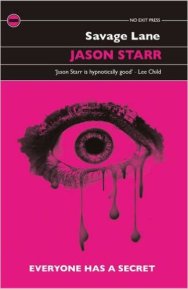
Jason Starr’s latest release Savage Lane is a dark thriller that highlights the pervasiveness of fantasy, the unconscious and risky desire of release by those guilty of deceit, the costs of unaddressed ‘friendly’ banter & rumour, the belief of children that adults don’t lie and the consequences of it all…
Savage lane, is a savage place and I would NOT want to live there. Truth is a misnomer, whilst fantasy and ego, hidden behind a ‘High Paid Father” and “Soccer Mom” society is the norm. With neighbours like these? I’d run the other way..
Today, LifeOfCri.me recommends Savage Lane as a great read, and says Thank You to Jason Starr for taking time out of his launch schedule to answer a few questions…
LOC: Can you tell us a little about Savage Lane, and your inspiration for the story?
JS: It’s a dark domestic thriller about a group of dysfunctional people in an affluent submit of New York. A recently divorced woman is at the center of the story. Unknown to her she is the object of affection of an unhappily married man, and she also becomes the target of twisted psychopath. It’s a tense thriller, but there’s a lot of satire in it too.
LOC: We’ve all lost ourselves in the occasional fantasy, yet your characters seem to take this to another level, how challenging was this to write?
JS: I wanted to make the characters as real and identifiable as possible. Yes, their behavior is heightened, partly because I wrote the book from a close third person point of you. I wanted readers to be privy to the darkest, most intimate thoughts of each character, to amp up the psychological tension. The challenge was in keeping the momentum of the story moving forward and still tell a story that is very behavioral. When I’m writing I love to push myself, though; that’s a big part of the joy I get from writing.
LOC: So what is your writing space like, and do you have a regular writing routine?
JS: I don’t have any writing space! By design actually. I much prefer to leave my apartment to write, so my “office” is a combination of coffee bars in Manhattan.
LOC: What are you working on at the moment / What’s next for you?
JS: I’m at work on a new psychological thriller, a TV pilot that I’m co-writing, and a new comics project. I prefer to work on a few projects at once–keeps things fresh and I’m more creative under pressure. I love deadlines.
LOC: What’s the best piece of writing advice you’ve every received?
JS: Good question! Ronald Ribman, a family friend who is a successful playwright, once advised me to always say “Yes” to opportunities. I didn’t take this to mean to take on projects that don’t excite me, but in general it’s a huge mistake for a writer to turn down work because they think they are too busy. Say yes and find the time.
LOC: Who inspires you?
JS: Everyone who ever rejected me or didn’t get behind my career.
LOC: In between projects how do you like to relax / enjoy your spare time?
JS: Spend time with my daughter, family and friends. Read, see movies and plays, a day at the racetrack.
LOC: What’s the strangest sentence you’ve written/read this week?
JS: Haven’t written much this week–been mainly traveling a promoting Savage Lane!

My name is Stuart Gibbon and I’m a former police DCI turned Writing Consultant.









 Life of Cri.me