Posted in Author Q&A's, Blog Touring, Guest Posts

Asked and Answered – Jason Starr

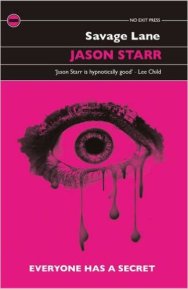
41lhRv2HMRL._SX322_BO1,204,203,200_Jason Starr’s latest release Savage Lane is a dark thriller that highlights the pervasiveness of fantasy, the unconscious and risky desire of release by those guilty of deceit, the costs of unaddressed ‘friendly’ banter & rumour, the belief of children that adults don’t lie and the consequences of it all…

Savage lane, is a savage place and I would NOT want to live there.  Truth is a misnomer, whilst fantasy and ego, hidden behind a ‘High Paid Father” and “Soccer Mom” society is the norm. With neighbours like these? I’d run the other way..

Today, LifeOfCri.me recommends Savage Lane as a great read, and says Thank You to Jason Starr for taking time out of his launch schedule to answer a few questions…

LOC: Can you tell us a little about Savage Lane, and your inspiration for the story?

JS: It’s a dark domestic thriller about a group of dysfunctional people in an affluent submit of New York. A recently divorced woman is at the center of the story. Unknown to her she is the object of affection of an unhappily married man, and she also becomes the target of twisted psychopath. It’s a tense thriller, but there’s a lot of satire in it too.

LOC: We’ve all lost ourselves in the occasional fantasy, yet your characters seem to take this to another level, how challenging was this to write?

JS: I wanted to make the characters as real and identifiable as possible. Yes, their behavior is heightened, partly because I wrote the book from a close third person point of you. I wanted readers to be privy to the darkest, most intimate thoughts of each character, to amp up the psychological tension. The challenge was in keeping the momentum of the story moving forward and still tell a story that is very behavioral. When I’m writing I love to push myself, though; that’s a big part of the joy I get from writing.

LOC: So what is your writing space like, and do you have a regular writing routine?

JS: I don’t have any writing space! By design actually. I much prefer to leave my apartment to write, so my “office” is a combination of coffee bars in Manhattan.

LOC: What are you working on at the moment / What’s next for you?

JS: I’m at work on a new psychological thriller, a TV pilot that I’m co-writing, and a new comics project. I prefer to work on a few projects at once–keeps things fresh and I’m more creative under pressure. I love deadlines.

LOC: What’s the best piece of writing advice you’ve every received?

JS: Good question! Ronald Ribman, a family friend who is a successful playwright, once advised me to always say “Yes” to opportunities. I didn’t take this to mean to take on projects that don’t excite me, but in general it’s a huge mistake for a writer to turn down work because they think they are too busy. Say yes and find the time.

LOC: Who inspires you?

JS: Everyone who ever rejected me or didn’t get behind my career.

LOC: In between projects how do you like to relax / enjoy your spare time?

JS: Spend time with my daughter, family and friends. Read, see movies and plays, a day at the racetrack.

LOC: What’s the strangest sentence you’ve written/read this week?

JS: Haven’t written much this week–been mainly traveling a promoting Savage Lane!

For the LifeOfCri.me quick fire round

Fact or Fiction? fiction

Film or TV? TV

Book or E-book? Book

Cats or Dogs? Dogs

Early Mornings or Late Nights? Both

Hot or Cold? Huh?

Relaxing or Adrenaline Fuelled? Relaxing


Savage Lane is out now in paperback, e-book and as an audible download…

Posted in Articles, Blog Touring, Guest Posts

David Young On Trabants, Ketwurst and Blue Stranglers

Debut novelist David Young’s first Oberleutnant Karin Muller novel, Stasi Child is out now for Kindle, and here as part of his blog tour, David talks to LifeOfCri.me about a few of those things particularly loved by the East Germans.


imageEast Germany – or more properly, the German Democratic Republic (Deutsche Demokratische Republik in German) – is now a lost world, and many would say that’s for the best, trapped as its citizens were behind the fortified Berlin Wall and the inner German border.

But twenty-five years after the two Germanies reunited (the anniversary was earlier this month), there are still some things from the communist state that its former inhabitants hanker after. It’s spawned a form of nostalgia with its own name – Ostalgie. In my novel Stasi Child there are plenty of references to products and brands which were peculiarly East German. Some were so popular they still survive today.

Cars

My detective, Oberleutnant Karin Müller, and her deputy, Unterleutnant Werner Tilsner, drive around in an unmarked police Wartburg. But the most iconic East German car was the much-maligned Trabant. The Trabi can still occasionally be seen on the streets in eastern Germany today, even though it was made out of a strange product called Duroplast – a mixture of recycled cotton and resin. It had a horribly inefficient two-stroke engine, a top speed of 62 mph, and emitted between five to nine times the pollution levels of even an average 2007-vintage western European car. Nevertheless, they were much sought after, with citizens often on a years-long waiting list, so lucky owners maintained them meticulously. Wartburgs – a step up from the Trabi – were made of steel, and were even exported to the UK. Müller and Tilsner in Stasi Child would probably have driven a Wartburg 353 – nicknamed ‘Farty Hans’ because, like the Trabant, it was a two-stroke with copious exhaust emissions.

Food

In the original draft of Stasi Child, I had Müller eating a Ketwurst – a ketchup wurst (the German name for sausage) bought from an outdoor stand. The Ketwurst was an East German ‘invention’ – developed by the fantastically-titled State Gastronomic Research Centre – to rival the American hot dog. Then I discovered it didn’t come into being until 1977 or ’78, while the novel is set in 74/75. So instead she wards off her hunger with a quarter Broiler. The broiler was simply grilled or fried chicken and an East German fast food staple.

Other famous East German food products include the ones listed by my teenage characters in the second, parallel narrative of Stasi Child. For example, Nudossi (sometimes nicknamed Ost-Nutella) – a hazelnut and chocolate spread which actually has a higher proportion of hazelnuts than its western equivalent and is still produced today (it’s delicious!). Another is Spreewald pickles – pickled gherkins in glass jars produced in a wooded area 100 kms south-east of Berlin, which famously feature in the film Good Bye Lenin! Then there was the GDR’s answer to Coca Cola: Vita Cola, advertised as a ‘carbonated soft drink with fruit and herb flavoring’ and like its more famous western cousin, produced according to a ‘secret recipe’.

There are still restaurants in the eastern part of Germany where you can sample traditional East German dishes. One of them – the restaurant attached to the DDR-museum in Mitte – serves the favourite dish of Müller’s husband, Gottfried, Gebackene Apfelringe (baked apple rings). This features in a particularly harrowing scene in the novel.

Alcoholic Drink

Drinking alcohol was almost a national pastime in East Germany. The GDR’s official youth movement, the FDJ, even had a song about drinking beer. In the mid 1970s – when Stasi Child is set – an East German medical specialist estimated that 5% of adults in the GDR were alcoholics: four times as many as in West Germany. In my opening scene, Müller and Tilsner wake (in Tilsner’s marital bed!) with hangovers after downing too much Blue Strangler the night before. Blue Strangler in the early days of the GDR referred to 40% proof crystal vodka, and got its nickname from the blue label of the bottles (a later version actually branded as Blue Strangler was actually a grain schnapps of lower alcohol content). Although former East German detectives I spoke to insisted there was no drinking on duty or during a case, alcohol was part of daily life. East German women’s magazines even advised a special diet for those wanting to lose weight: the wurst and vodka diet!

Interestingly, when the 1989 protests which led to the dismantling of the Berlin Wall and East Germany began, alcohol consumption slumped to historic lows within a matter of weeks.


Stasi Child by David Young is out now in ebook. The Paperback will follow in February 2016.

Posted in Blogging

Twelve words.

There was a time in the late nineties / early noughties when I spent all my spare time entering competitions, and I was good at it.  My list of wins is long, adventure packed and value wise topped £50k in the years I was active.  During this time my preferred competitions were those where I needed to complete a sentence or phrase in a limited number of words.  The other day I was reminiscing over these days and it gave me an idea for a new feature, a spin on the usual Q&A the plan is to ask authors a handful of questions, but they could only answer in maximum of 12 words.

I spoke with a few author friends who all seemed up for the challenge, so once I get round to writing and sending out a few questions, get ready for a new series, it could be fun….

Posted in Reading, Reviews

Evil Games – Angela Marsons

imageThe greater the Evil, the more deadly the game…

When a rapist is found mutilated in a brutal attack, Detective Kim Stone and her team are called in to bring a swift resolution. But, as more vengeful killings come to light, it soon becomes clear that there is someone far more sinister at work.

With the investigation quickly gathering momentum, Kim finds herself exposed to great danger and in the sights of a lethal individual undertaking their own twisted experiment.

Up against a sociopath who seems to know her every weakness, for Detective Stone, each move she makes could be deadly. As the body count starts to mount, Kim will have to dig deeper than ever before to stop the killing. And this time – it’s personal.

…a genuine one sitting read….

Back in the Black Country, back with DI Kim Stone, who in this cracking sequel finds herself locked in an evil mind game, with a deadly opponent.  If you enjoyed Silent Scream, you will love Evil Games. Faster, and more adrenaline fuelled, and with a truly evil antagonist who is destined to get under the skin of the troubled yet feisty DI, it’s a genuine one sitting read, as its villains heinous plan is slowly revealed.

It’s another gripping plot that will enthrall you, and make you question just how easily one person can manipulate another.  Beginning in court with the trial of a mother accused of trying to kill her child, a series of unrelated crimes are slowly revealed to be linked but only Stone knows who is behind it all. The difficult part is finding, someone, anyone who believes what she knows and can help her prove it.

I’m still amazed that this is just the second outing for Angela Marsons, serial character DI Kim Stone, as the writing is solid, the characters even more intriguing and the cracks in Kim Stone are cleverly picked at, giving us greater glimpses of both her weakness, and her inner strength.  A character with such a mixed and difficult background that I’m already looking forward to the next installment.


Posted in Reading, Reviews

Silent Scream – Angela Marsons

imageFive figures gather round a shallow grave. They had all taken turns to dig. An adult sized hole would have taken longer. An innocent life had been taken but the pact had been made. Their secrets would be buried, bound in blood …

Years later, a headmistress is found brutally strangled, the first in a spate of gruesome murders which shock the Black Country.

But when human remains are discovered at a former children’s home, disturbing secrets are also unearthed. D.I. Kim Stone fast realises she’s on the hunt for a twisted individual whose killing spree spans decades.

As the body count rises, Kim needs to stop the murderer before they strike again. But to catch the killer, can Kim confront the demons of her own past before it’s too late?

I picked up Silent Scream not just as a fan of crime fiction, but also because finally there is a book that has been set where I grew up.  My Great Great Grandfather’s portrait hangs in the pub in The Black Country Museum, and if you mention the names of either of my Grandmothers to many of the staff working there, they’ll know exactly who I am. I’m a proud direct descendent Black Country girl, who’s moved away from home, and the memories that have been brought to mind of the places I lived, played and went to school have been a delightful aside.  I also believe it’s one of the things that helps with the mystery and intrigue of Silent Scream. With so many modern-day novels set in big cities or rural backwaters, it’s fantastic to see something in a setting more accessible to many, with its own quirks and issues of just who polices whom.

I absolutely loved the character of Kim Stone, and not only because of a shared loved of Kawasaki motorbikes.  I enjoyed the way that rather than being given a motorbike as transport in an effort to ‘butch up’ her personality, our feisty DI is but a true petrol head with a passion for bikes old and new.   She’s a sarcastic, rule breaker who, despite her childhood, cares more for her team than she’d like to let on.  Gritty, and determined, this DI is one fantastic character you’ll immediately want to get behind with a great line in sarcasm that will genuinely make you smile.

With a great cast of supporting characters around her, all of whom are well-developed and will have you keen to learn more about them, what’s most surprising about Silent Scream is that it is a debut novel. It’s cleverly put together with an intriguing plot that pull you in and have you whizzing through pages.  I’m definitely adding Angela Marsons to my ‘authors to watch’ list.

Posted in Author Q&A's, Guest Posts

Asked and Answered – Christopher Fowler

CFowler2A while ago I got to ask a few questions of the delightful Christopher Fowler.

Chris is a prolific writer of books of many genres, who is currently most notable for his series about the adventures of octogenarian detectives Arthur Bryant and John May, and their increasingly antiquated, much maligned and yet highly successful Police Department,  The Peculiar Crimes Unit.

His latest book Bryant & May: The Burning Man is out now.


LOC: The Burning Man marks the end of the second overreaching story arc’s in the Bryant and May series, what’s next? will we be seeing more from our favourite octogenarian pairing?

CF: The cat’s out of the bag now, Jo…I’ve been signed to more, but I’d always planned to go on – and I’d planned a way of doing so even though it appears that I’ve written the characters into an impossible corner.

LOC: My personal favourite of the series so far has been White Corridor, because of its shorter timescales, and for taking Bryant & May out of their comfort zone.  What’s your favourite Bryant & May novel and why?

CF: Ah – that’s one of my ‘precinct’ tales, where you deliberately limit your options. They’re hard to write but very satisfying. I plan to do another soon. If you look at the timescales you’ll find that nearly all of the stories take place over one week and in exactly 50 chapters. I really love ‘The Burning Man’, but then I tend to be proudest of the latest one anyway.

LOC: I have a long drive to work each day and regularly listen to audio books.  I’ve ‘read’ all of the previous Bryant & May novels this way.  Tim Goodman is a fantastic narrator, how much input did you have in selecting him, and into the production of the audio books?

CF: I didn’t, but as soon as I heard him I knew we were in a safe pair of hands. I think they’ve done an unusually fine job on the books, and I hope Tim stays in there for a long time.

LOC: If they were ever brought to the Film or the TV screen, who would you like to see in the roles?

CF: Well the rights have been sold several times, once with Derek Jacobi attached. I think Toby Jones would be a great Bryant. There’s a theme tune for the show on YouTube and on my blog, written by Des Burkinshaw. Crippen’s on it! 

LOC: What’s your writing space like, and do you have a regular writing routine?

CF: I have two very different writing spaces, one in London, in a minimalist space on an entirely glass table with no papers anywhere, the other in Barcelona on a pre-Franco voting ballot-table covered in papers and ink stains.

LOC: What are you working on at the moment?

CF: I recently finished ‘The Sand Men’ a paranoid and very sinister thriller set in Dubai, which comes out in October (I think) from Solaris. And ‘Bryant & May: London’s Glory’, a collection of their forgotten cases, comes out in time for Christmas this year.

LOC: What’s the best piece of writing advice you’ve ever received?

‘CF: You don’t need to explain why people fall in love, you just need to know that they do.’ That, and ‘Dialogue is not conversation.’

LOC:Who inspires you?

CF: Gad, where to start? People in the street; I’m a good observer (harder than it sounds). Lots of writers from Dickens to Joe Orton to JG Ballard, and a lot of female American crime writers from the 1950s.

LOC: You obviously have a great deal of love for London, and its myths, magic and legends.  How do you go about discovering these and carrying out research?

CF: I walk a lot, have an insane collection of strange London books (‘The Lost Cinemas of Camden Town’, anyone?), and have a tendency to make connections that only seem obvious when you put them together. Then once I have a hypothesis, I go out and see if it could be true. In ‘The Burning Man’, it seemed obvious to me that there was a connection between Guy Fawkes and the banking riots.

and for the LifeOfCri.me quick fire round…..

Bryant or May? Both, plus London

Fact or Fiction? Both, plus Surreality

London or Barcelona? Both 

Historical or Modern? Both, plus Future

Crime or Sci-Fi? Both, plus alt. timeline

TV or Film? Both

Book or E-Book? Both


You can find more about Christopher Fowler can be found on his website christopherfowler.co.uk  where he blogs on a daily basis or you can follow him on twitter @Peculiar

Posted in Reading, Reviews

Lives Lost – Britta Bolt

imageA minute can make all the difference…

Pieter Posthumus is enjoying a quiet drink in his favourite bar when the screaming starts. A minute later, the owner of the guesthouse next door rushes in: one of her tenants has been murdered.

Marloes, the guesthouse owner, is an odd but kind soul. Posthumus cannot believe it when she is arrested – for both her tenant Zig’s murder and another death years before. He knows there are questions unanswered: what is the link between the two cases? Why are people so keen to think Marloes is guilty? And why did Zig paint just one picture every year – a copy of a Dutch master, but with one peculiar twist?

As his investigation progresses, he comes to see that a few minutes can mean all the difference in the world: between saving a life and taking one; between innocence and guilt. And that sometimes asking questions leads to a truth that’s hard to bear.

Absolutely loved it….

Lives Lost is the second part of a trilogy featuring protagonist Pieter Posthumus, but if you haven’t read Book One, Lonely Graves yet, don’t worry.  Lives Lost stands well on its own, there is enough detail in there to make you determined to go back and pick up the first book, without spoiling it for any reader, and  trust me, if this is your first Posthumus novel, not only will you go back, but you’ll be pre-ordering the next book too.

Set on the outskirts of Amsterdam’s red light district, the sense of camaraderie amongst the main characters is fantastic, making the best of their community, and of those who come and go amongst them.  The humanity of the whole setting is one of my favourite things about this series, from Pieter, who loves to cook, Cornelious, the poet and art lover, to Anna the bar owner of generations past and Marloes the mother hen, every character has been depicted brilliantly, to just the right degree that no one feels like they’ve been exaggerated in any way.

Clearly torn between following his instincts and supporting his friends, when Posthumus does begin to investigate the mystery at the heart of Lives Lost he shows himself to have a keen eye for detail, a remarkable mind for making connections and an enlightened view of memory which works well to ensure that you can follow him through his deductions to the, by then, inevitable conclusion.  The whole ‘investigation’ feels natural, perfectly paced, with real doubts and deductive leaps, it never once leaves you feeling like it’s ‘just a story’, and any crime writer worth his salt will tell you that, that’s what makes it worth it….